
Three corridors west of I-15 — Airport, California Avenue, and West Valley — hold roughly 110 million square feet of industrial, about two-thirds of Salt Lake County's entire base. For the past two years the story across all three was uniform: heavy deliveries, rising vacancy, landlords playing defense. That chapter is ending, and the three corridors are now on visibly different paths. The divergence matters for anyone pricing a lease, underwriting an acquisition, or timing a disposition on the west side.
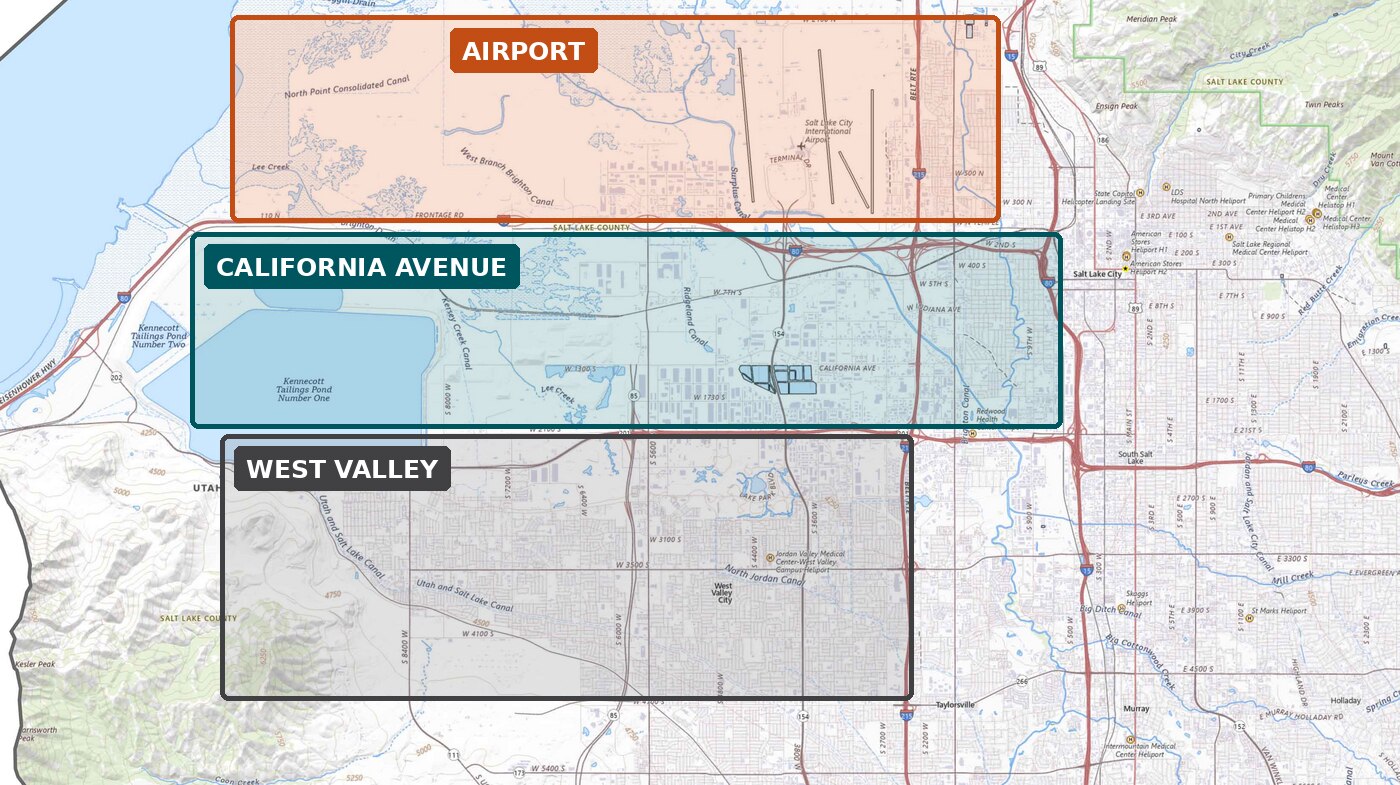
| Subarea | Inventory | Total Vacancy | Avg Asking Rent (NNN / mo) |
|---|---|---|---|
| Airport | 28.5M SF | 12.6% | $0.68/SF |
| California Avenue | 58.8M SF | 6.7% | $0.87/SF |
| West Valley | 22.8M SF | 7.3% | $0.80/SF |
Airport: the growth frontier
Everything north of I-80 — the airport environs, the International Center, and the Northwest Quadrant's master-planned parks — carries the county's highest vacancy at roughly 12.6% (published figures run 9–13% depending on survey basis). That number reads soft until you see what's underneath it: the Airport corridor absorbed about 1.3 million square feet in the second quarter alone — roughly three-quarters of all net absorption in the county — and accounted for nearly half of all leasing activity. It also took delivery of about 854,000 square feet, essentially all of the county's new supply this quarter, much of it completed already-occupied by build-to-suit and owner-user commitments.
Asking rents here are the county's most competitive at roughly $0.68–0.75 NNN, which is exactly what a lease-up market looks like: landlords with new big-box product competing on rate and terms while demand catches up. The structural story hasn't changed — direct I-80 access, airport adjacency, and a labor pool deepened by housing growth on the west bench and in Tooele County. Vacancy out here is a pipeline artifact, not a demand problem, and at the current absorption pace it has a shelf life.
California Avenue: the anchor holds
California Avenue — the band between I-80 and SR-201 — remains the center of gravity: close to 59 million square feet, roughly a third of the county's industrial inventory. Vacancy sits at 6.7%, the corridor has absorbed about 1.5 million square feet year-to-date, and asking rents around $0.87 NNN hold the middle of the market. The active pipeline of roughly 770,000 to 1.3 million square feet is meaningful but small against a base this size.
Long term, nothing on the west side matches this corridor's fundamentals: I-15, I-80, and I-215 within minutes, airport adjacency, and the deepest labor and consumer access in the state. Functional mid-bay product here stays leased, and owners have held pricing through the entire supply cycle.
West Valley: the slow lane, for now
West Valley — south of SR-201, roughly 23 million square feet — is the one major corridor still giving space back: about 229,000 square feet of negative absorption in the second quarter and roughly a quarter-million negative over the trailing period. Vacancy prints anywhere from the high-3s to low-7s depending on survey basis, and asking rents of $0.80–0.89 NNN have held flat rather than fallen. The connectivity is real — SR-201, I-215, and Bangerter tie it into everything — but the corridor's older mid-size stock is competing against newer product one corridor north, and it needs time for that to re-balance.
What we'd do with this
Tenants with big-box or new-construction requirements should be working the Airport corridor now — the widest selection and most competitive economics in the county, with an absorption pace that says the best blocks won't repeat in 2027. Owners on California Avenue hold the strongest hand for steady pricing on renewals; functional product there doesn't need to discount. West Valley owners should compete on realism — retention beats re-tenanting against newer supply one corridor north. And for investors, the spread between a 12.6%-vacancy lease-up corridor and a 6.7%-vacancy anchor argues for underwriting each corridor on its own demand drivers, never a blended county average.
If you own or occupy industrial on the west side and want this cut against your specific building, that's a fifteen-minute conversation — reach out.
NEXUS analysis of Q2 2026 Salt Lake County industrial submarket survey data (standard county submarket geography: Airport, California Avenue, West Valley). Published figures vary modestly across surveys; ranges shown where they differ. Information herein is deemed reliable but not guaranteed. This article is market commentary, not investment advice; verify all figures independently before relying on them in a transaction.